Carolina Cycling News Has Closed as of December 2012
For a number of years Carolina Cycling News was the best source for cycling in the Southeast
Content is from the site's 2010- 2012 archived pages providing a brief glimpse of what this site once offered its readership.
The new owner of the site's domain invites you to take a nostalgic trip back.
APRIL 13, 2013
Carolina Cycling News Update

If you’ve stopped by CarolinaCyclingNews.com since the beginning of 2013, you’ve seen the announcement that we closed the site on December 31, 2012. Although we were sorry that there wasn’t adequate advertiser and sponsor support to continue publishing it, we’re proud of the coverage we provided for cycling in Greenville, South Carolina and the broader Southeast region for almost 3 years.
We’re still big fans of the local cycling scene and look forward to future opportunities to promote it.
Thanks to all our contributors who helped make this site a great resource!
Neil & Pamela.
Carolina Cycling News is the best source for cycling in the Southeast. Here cyclists in the Carolinas and surrounding areas can easily find local resources and information they need in an organized format: event calendars, news, group rides, club listings, bike shops and more.
Carolina Cycling News celebrates the culture of the sport and features glimpses into the great local destinations you shouldn’t miss when traveling to cycling events.
Promoting the sport of cycling is part of the Carolina Cycling News vision:
- introduce new fans to the sport
- support the dedicated cyclist
- collaborate with the hard working organizers who make great events happen
We hope you enjoy the website and will let us know how we can make it better!
About Carolina Cycling News
We founded Carolina Cycling News in April 2010 to bring attention to the great cycling scene in the Carolinas and greater Southeast region, provide resources for local cyclists and support event promoters.
We encourage you to contact us with questions and to submit race reports or event listings.
Neil Browne, Co-Founder
Neil grew up in a cycling family, listening to the tales of his father’s experience as a professional racer in Ireland. His journalism career has included five years as the editorial director of a national cycling magazine, writing articles for Cyclingnews.com, VeloNews.com, Velonation.com and Paved Magazine and as a columnist for RoadCycling.com and Versus.com. You can also find his personal blog at NeilBrowne.com.Pamela Wood Browne, Co-Founder
Pamela is a cycling fan and recreational/commuter cyclist with family roots throughout the Southeast, especially Greenville, SC and East Tennessee. Her background is in design, technology and urban planning.
When we founded Carolina Cycling News in April 2010, we did not know that we would be losing both of our fathers in the same year. Thomas Browne and Burrell L. Wood, Jr. both enjoyed storytelling. It seems appropriate to dedicate Carolina Cycling News to them. Not only do we try to share good stories, but we are inspired by Tom’s love of bike racing and B.L.’s love of the people and history of the Carolinas and Tennessee.
"We were avid readers of this periodical and it helped our team keep us informed and motivated as we trained and competed in state and nationally. We were inspired by the stories of winning strategies and discovered that even small tactics can make a huge difference if you believe in them. For example, we read about how uniforms can help teams unify - this is completely true and although we could not afford actual uniforms, we, as avid Batman fans, decided to let Batman be our guide. We found an amazing website that sold Batman apparel and chose T shirts featuring batman characters as our uniform. This was inexpensive, effective and everyone was on board, but more importantly, when we entered competitions, we all felt a sense of team spirit, guided by the Dark Knight. I know this may sound silly, but Batman is a force to be reckoned with and he was always on our side as a result of our ersatz uniforms." Carol Knolls

2012 BLOG POSTS
What is training?
MAY 25, 2012 BY DAVID CURRAN
What actually happens when we train and, more importantly, why does it work? This is kind of a big question and one that I’m not likely to be able to do justice to in 600 words or less. But, since this is something I think is very important, and often misunderstood, I think its worth going into.
First things first, why do we train? Well, duh, to get faster. OK, but why do we train to get faster instead of just going out and trying to ride faster all the time? It seemed to work when you were getting started in a sport. The more you worked out, the better you got. Simple! Unfortunately, at some point, that stops working and it seems that no matter what you do, you just hit a peak and stop improving.
That’s because when you started you were essentially “untrained”. So anything you did made you more fit than you were the day before. And likely, you weren’t dedicated enough (yet) to push through fatigue or pain and so you gave yourself rest. And then, lo and behold, you were fit(er)!
Now, you ride or run every day, you compete on weekends, you do group rides, trainer sessions, 100 mile training rides, etc. Fortunately, you’ve adapted to all this work and your body can handle it. Unfortunately, you’ve adapted to all this work and your body can handle it… This means no new gains in fitness will come without pushing past your current level and creating the same adaptations you did when you first started.
The graphic above gives us a nice neat picture of what’s happening. You start at a point, you do enough work to make you tired, and then you rest. During rest, you supercompensate, or adapt, because what doesn’t kill you literally makes you stronger, and then you reach a new level of fitness. Lather, rinse, repeat! Well sort of…
If you just went out every day and tried to run yourself into the ground and then took a few days off, you’d likely not get anywhere. This is where specificity comes in. Jim wrote a great article on this so I won’t bother to rehash it too much. I’ll only say that if you want to get better at a certain aspect of your sport, then you have to work specifically on that aspect for a period of time. More importantly, you need to work beyond your current capability. This is the only way to induce fatigue and then the awesomeness of adaptation that comes later with rest.
Did I mention rest? Let me throw another graphic at you:
Notice that there is recovery in this picture, but its not enough. If you don’t give yourself time to fully recover and then adapt, you end up just making yourself more tired. Imagine starting a trip with a full tank of gas. You drive 100 miles then stop and put in just a little less than a full tank and drive another 100 miles. If you continued to do this, you’d run out of gas. Running out of gas is bad, mmkay?
So, to recap:
1. Training is a progressive overload that causes fatigue.
2. Fatigue requires rest to recover
3. Once recovered, your body adapts/supercompensates to the stress and reaches (hopefully) a new level
4. Eventually you’ll reach a level of diminishing returns and you’ll need to train a different system for a period to see other gains.
Wait…what was that last one!?!?! You mean I can’t get a 500W FTP if I just constantly train it? Well, sadly, no. There’s a limit to what we can do through training and eventually, even under perfect conditions, we all hit it. Sadly, this is your parent’s fault, not yours. However, fortunately, most races require a pretty large toolbox of capabilities. There’s always something else to train. Maybe it’s your sprint, or climbing, or cornering (yes, you train skills, too) or time trialing, there’s always something to improve.
So there ya go. It’s not exactly a PhD course in exercise physiology, but it covers the basics. If you have any topics or questions you’d like to see answered, drop us an email or a comment below.
David Curran
David is a Greenville Cycling Center Affiliate Coach. As a network engineer, father of three, and husband, he knows how how hard it is to come by training time. His goal as a coach is to help his athletes balance their desire to compete at their highest ability with their responsibilities to work and family.
Pedaling Technique – CYCLING EFFICIENTLY
SEPTEMBER 28, 2012 BY CCN.COM
The bike is an efficient machine that is so good at converting our energy into speed that the limits of our efficiency become obvious at the hardest efforts. Cycling efficiency can be influenced in many ways. You can either improve the supply side – power output and pedaling skill; or demandside –overcoming wind resistance by improving aerodynamics, and gravity via minimizing body and bike weight. This article will however, will focus on pedaling technique and drills.
The bike crank set; with 2 rigid directly opposed levers – can hide inefficiency, but the smoother and more efficient pedaling becomes, the less energy you require to produce power. Key ways to improve efficiency include:
- Pedaling smoothly thru the two dead spots at top and bottom of the pedal stroke.
- Using cadences that are appropriate for the situation to create pedaling momentum and transfer the effort onto the cardiovascular system and reducing muscle load.
- Having, more supple, less choppy stroke rotation (i.e. no mashing, pedaling squares, or ‘elongating’ the cranks).
- Learning to relax non-essential muscles, including antagonist leg muscles, postural and even facial muscles.
Pedaling Circles
The goal is to subtly guide the pedals around in smooth circles; not wasting muscle energy on overcoming unproductive muscle tension, joint stiffness, or lifting the 25 plus pounds of dead weight of the recovering leg. This load could be even greater if your saddle is too low and/or if joints or muscles are stiff and resist the knee flexion at the top of the stroke. Muscle activity measures have shown negative force vectors resisting the pushing leg beyond the weight of the recovering limb!
An easy test is to unclip one foot and let one leg do all the work. Deficiencies are revealed immediately.Hip flexors and hamstrings will howl. The same muscles we feel when we isolate one leg are the same ones we need to strengthen and teach to contribute to the stroke.
Analysis of the pedal /stroke will often reveal weak hip flexors and hamstrings compared to the more dominant quadriceps. Hip flexors, while not designed as prime movers, are often under-utilized in cycling. The hamstrings also have the potential to contribute to the pedal stroke, but minimally they should be strong and supple enough to get out of the way. There must be conscious neuromuscular conditioning to make that happen.
Left Leg/Right Leg Balance
There can be disparity between left and right pedal strokes. One leg can be dominant and the other along for the ride. One leg can have greater girth and subtly different musculature. You may also feel the dominant leg is more quad driven and the weaker leg more hamstring driven. This lack of symmetry can lead to losses in efficiency, and invite injury. Over time, a cyclists’ quads tend to strengthen, shorten, and overwhelm the antagonizing hamstrings. Single leg pedaling will uncover discrepancies.
Correcting the problem
If you discover a faulty pattern in your single-legged pedal action, make an effort to reverse it. Doing proprioceptive pedaling and single-legged drills regularly will be the first step. When you pedal, be aware of your tendencies to revert to your old program, and correct it. Be persistent and patient. Training aids like PowerCranks can be useful but expensive. Single-leg drills and Proprioceptive drills will cost you nothing and are very effective. Spin Scan sessions can provide feedback while you progress.
Additionally regularly stretch the quads, and effectively and properly work the core to help rotate the pelvis posteriorly. Strengthening hamstrings and hip-flexors in general will aid in this posterior adjustment. Do 10 minutes of Proprioceptive and/or single-leg drills nearly every ride. They should be low resistance at first. As you become more proficient, progress slowly. Revisit the drills several times during the course of a ride to reinforce the patterns. There is plenty of recovery riding, warm-up, and cool-down time to work this process. When you’re working intensely, or racing, just monitor your form now and then, cut loose and go.
STEPS TO IMPROVING YOUR PEDAL STROKE
Analyze Position, Pedal Stroke and Muscular Function
- Make sure your bike is fit properly. If your saddle isn’t high enough, you can’t get the foot over the top of the stroke effectively. If you must enlist your postural and arm muscles to hold you in place, or contract your quads to unweight your body off of an uncomfortable saddle then you are wasting a lot of energy.
- Get a Spin Scan done. Find out how balanced and circular your pedal stroke is.
- Do isolated pedaling to see how strong and coordinated your hip-flexors and hamstrings are.
- Be observant of unequal strength and coordination between right and left legs.
PEDALING CIRCLES SKILL DRILLS
The drill descriptions are based on the pedal stroke overlays the face of a clock with the crank arm being the hour hand. These drills are done with both legs clipped in and are perfect to do on any road/trail ride.
Focus on Stroke Clock Quadrants:
- Push down 2-5 o’clock
- Scrape back 5-9 o’clock
- Lift/Drive knee toward Handlebars 9-11 o’clock
- Kick or flick over top 11-2 o’clock
Shift Quadrants by 1-2 hour positions occasionally.
SKILL DRILL #1a will bring awareness and coordination to each portion of the pedal stroke.
Around the Clock Same Quadrant
Single Quadrant Focus by both legs; alternating legs:
Push down L, push down R x 20 strokes each.
Scrape L, scrape R x 20 strokes each.
Lift/drive R, lift/drive L
Kick over R, Kick over L
SKILL DRILL #1b will bring coordination to each leg working together to simultaneously push/pull.
Around the Clock Coordinating Opposite Quadrants
Push down R AND lift/drive L” x 20 strokes each.
Scrape R AND kick/flip L” x 20 strokes each.
Reverse the legs and repeat for other side.
SKILL DRILL #2 will put it all together one leg at a time.
Single leg focus full circle
Focus on feeling and guiding one pedal in a full circle with other leg clipped-in but completely limp. Alternate 10, 20 eventually 30 strokes each leg with dominant leg first, non-dominant second, then meld into coordinating both legs together third. Repeat 3-6 times with some uphill.
This can then evolve into some single leg pedaling drills with 1 leg clipped out on an indoor trainer.
Left/Right Asymmetry Correction Drills
1. Do 30% more of Proprioceptive and one-legged drills with weak leg.
2. Ride up a hill or under any real load thinking “Left, Left, Left” [assuming the left leg is the weaker leg] on each left-leg pedal down stroke. Don’t push a lot harder with the weaker leg, just mentally count pedal strokes on that side. Simply mentally accentuating the ‘weak’ leg will eventually even out the torque curves of each leg.
In conclusion, efficient pedaling is a critical skill that takes time to develop. Efficiency isn’t the result of just cycling more. It requires a focused conscious effort toward enhancing technique. The bike masks our weakness. We can improve fitness, but if we ignore efficiency, we are not maximizing our performance potential.
by EDGE Endurance Training Center Owner and GCC affiliate Coach Dan Shelby, M.S.
Take Advantage of the Track!
JUNE 28, 2012 BY KYLEKNOTT
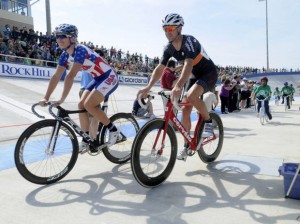
The Southeast is booming with opportunities for riders to get out on velodrome and take advantage of the track. Most riders are within a reasonable drive to one of the velodromes whether it be Dick Lane Velodrome (Atlanta, GA), The Mellowdrome (Asheville, NC), or the newest addition The Giordana Velodrome (Rock Hill, SC). Each facility has a weekly series that can be found on their websites (listed below) that would benefit any type of rider to try. Most will have you take a certification class so that you will know the track specific rules and safety concerns before being able to race.
A lot of people might shy away from the track thinking it is for sprinters or track specialists, but spending time training and/or racing on a velodrome will be beneficial for anyone willing to give it a go.
If you are struggle with maintaining fitness a weekly track workout or race will help you go beyond your usually capabilities without just doing intervals. Track races cause you to accelerate and maintain speed many times over each short race. A lot of times you are put in a position where you must bridge across to the winning move before it laps the field which will put you at VO2 max effort. This can be beneficial for a road rider who might not enjoy doing intervals alone and wants to mix it up with some weekly racing. The fact that you also do many races a night in an omnium style, you must be able to recover and get back out on track to do it again which does wonders for fitness.
If you enjoy time trialing the track would be great for you with events such as the 1K and the 4K. These events are tailored to different types of riders, but both will use a TT position. As a road rider or triathlete it can benefit you to go to the track and try some of these races for time in your TT position and strength on the bike workouts with the standing starts. The track is also a great place to tinker with your TT position because you can make minor adjustments then ride around the velodrome and come back in and make more adjustments without the boredom of riding a trainer or the fear of making adjustments on the side of the road.
For a rider who struggles with acceleration and sprinting the track would help with flying time trials or mass start events. As I mentioned acceleration over and over again are essential for success in track racing, so that would benefit a rider needed work in this category. Also most of the tracks will have a night where they do sprint events which you can get your time in the flying 200 and go back each month to these events to see the gains in your sprinting ability.
Overall I encourage you to check out your local or regional track for a way to mix up some training and improve weaknesses and maintain strengths. Each track has a different weekly series and one track might suit your needs better based on the events they have that week, so go ahead and give them all a try to experience the different scene and character that each offer.
KyleKnott
Kyle is a Greenville Cycling Center Coach. Focus: Road cycling and track. Education: Health and physical education teaching license. While competing for Mars Hill College he won the Division II Collegiate National Championships in the criterium, individual omnium, and team omnium.
Interbike – Pedal Chic named Best Bike Shop for Women
SEPTEMBER 22, 2012 BY PAMELA WOOD BROWNE
Greenville, SC is home to the first women-specific cycling shop and boutique in the nation. Pedal Chic. On Wednesday night, Founder Robin Bylenga received the BRAINy award for Best Bike Shop for Women at Interbike 2012 in Las Vegas. “We’re proud to be on the forefront of empowering women by combining fitness and fashion along with re-discovering the unique freedom of riding a bike.”
Bylenga is also one of the founders of SpokesWomen, a professional networking group for women in the cycling industry. Carolina Cycling News attended the networking eventhosted by SpokesWomen and the Outdoor Industries Women’s Coalition (OIWC) in the OIWC Women’s Lounge at the Interbike Expo. It was well attended, far surpassing last year’s numbers and spilling out into the surrounding aisles.
Pamela Wood Browne
Pamela, co-founder of Carolina Cycling News, writes our Slow Bike Upstate blog. She's a recreational/commuter cyclist and bike racing fan. Her background is in design, technology and urban planning
Interbike – globalbike Wipes Launch
SEPTEMBER 19, 2012 BY PAMELA WOOD BROWNE
Tanzania
Carolina Cycling News stopped by the globalbikes Wipes booth to check out the new wipes Spartanburg-based Athletix Products by Contec has launched at Interbike 2012 in Las Vegas. There are three different specifically formulated presaturated globalbike™ Wipes products – globalbike™ Body Wipes (Fresh Scent and Unscented), globalbike™ Chain Wipes and globalbike™ Hand and Tool Wipes. The body wipes are compostable and biodegradable and the chain wipes both clean and lubricate your bike chain. A percentage of proceeds from the wipe sales will be given to globalbike.
“Our partnership with globalbike is a win-win for our company,” said Jack McBride, Contec’s CEO. “We are especially excited to give away a gbconnect trip for two. This is a week-long trip, which will give participants a first-hand view of how a simple bicycle can bring dynamic transformation to the lives of less fortunate people. We believe it will be a life-changing event for the winners, too.”
globalbike and Contec, Inc., are also partnering to offer two free trips to Tanzania during Interbike. The trips will give recipients a chance to participate in globalbike’s signature program, gbconnect, which is a week-long transformative tourism trip that allows participants to stay in scenic sites that are receiving globalbikes, while helping with person-to-person handoffs of donated bikes to see how the vehicles make a difference.
“We guarantee that anyone who travels through gbconnect will not return home the same,” said Curt McPhail, President and Founder of globalbike. “This trip will transform how you see the world and how you can make a difference with something as simple as a bike.”
The next gbconnect trip is scheduled for May 31-June 10, 2013. If you’re interested in traveling through gbconnect, email info@globalbike.org.
More Southeast Sightings at Interbike
Sunshine Cycle Shop – John and Catherine James
Robin Bylenga of Pedal Chic on the runway at the Interbike Fashion Show
Southeast Interbike attendees share how they are enriching their local bicycling communities.
Pamela Wood Browne
Pamela, co-founder of Carolina Cycling News, writes our Slow Bike Upstate blog. She's a recreational/commuter cyclist and bike racing fan. Her background is in design, technology and urban planning.
2011 BLOG POSTS
A Metaphor Heavy Cycling Post on a Serious Topic
If you know me, or if you have read this blog, it is readily apparent that I live and breathe cycling. I think it is the most beautiful sport in the world. However, cycling is a fickle and cruel mistress that will not think twice about chewing a rider up and spitting him out on the side of the road like a wad of flavorless gum. In cycling, everything can go wrong so fast, whether it be an inopportune flat that sees you drifting of the back of a group right as the leaders launch their bid for victory, a crash that leaves you broken and unable to compete, or, drawing from my personal experience at last weekends national championships, a cramp on the penultimate lap.
Cycling doesn’t care whether you have good form, if you are the strongest guy in the race, or if you have the best equipment. If you race long enough bad and disheartening stuff will inevitably happen to you. The sport of cycling was described to me recently and rather aptly as trying to fill a punctured bucket with water–sometimes you can get the bucket to overflow, but eventually the water is going to come splashing out of the bottom of the bucket and you as a rider are going to be lost in the pain cave without a flashlight.
So how do we as a community of bike racers combat the seemingly looming defeat that circles us like sharks around chum? The answer is we remember why we got into the sport in the first place. We remember the fun and the freedom that bike racing provides and the satisfaction we feel when we win, knowing we did everything clean and by the book and knowing that for once we overflowed the bucket, fought of the sharks, and turned on the light in the pain cave.
Andy Baker
Andy Baker is a 21 year old Greenville SC native who races for the Bissell Pro Cycling Team. He has been cycling for over half is life, and is a junior history major at Furman University. In his spare time he enjoys watching movies, reading books (comic and otherwise), playing video games and spending time with his friends.
Hey Andy, Where The Heck Have You Been?
Written by Andy Baker on June 20, 2011 -

The title of this blog is a great question in and of itself. Since collegiate nationals I have logged numerous miles in all modes of transportation, suffered through two of the hardest one-day races in the world and helped propel Bissell to results that have solidified our standing as the number one continental team in the United States.
First stop on my whirlwind tour of America’s great bike races was in my own backyard at the US PRO TT and Road Race championships in Greenville, SC. The TT went pretty well for me. I hit out of the starting ramp really fast and held a pace that would’ve propelled me into the top ten (and my biggest ever result) but unfortunately the distance of the TT got to me and I cracked during the last lap and lost a minute and half which ultimately slotted me into 17th place overall. I was happy with my performance, but really lamented the fact I cracked so hard on the last lap.

Next up was the USPRO road race, during which my job was to cover the early break and basically just be at our team leaders’ beck and call. After an exceedingly fast first time up the climb (which saw half the field drop out of the race), Bissell put one guy into the early break. I made it over the climb and proceeded to get bottles and position our guys into the lead for the second time up Paris Mountain. Unfortunately this time up the climb my teammate in the break succumbed to the crippling heat of the day and came back to the field; that meant it was time for Bissell to chase! From the time the field left town until the base of the climb, I, along with two of my teammates and some Jamis riders, set pace to bring back the break. At the base of Paris Mountain, the third time up, my job done, I pulled the plug and leisurely climbed up the mountain. (Thanks for all the cheers, by the way!) Kyle Wamsley eventually placed fifth for the day, delivering a great result for Bissell Pro Cycling.
The morning after USPRO I hopped on a plane to scenic Allentown, PA. In Allentown I spent a couple days recovering, watching racing at the world famous T-Town Velodrome and getting ready for my next race the Basecamp International NRC crit in Basking Ridge, NJ. Bissell raced aggressively on the technical Basecamp course, but a UHC squad that was firing on all cylinders outmanned our small squad. However, Basecamp was a small appetizer compared to the full course meal that was our next race, the 156 mile Philadelphia International Championship otherwise known to the cycling world as Philly.
Bissell Pro cycling warming up the day before USPRO
Bissell, fueled up by a delicious Italian meal provided by one of our gracious sponsors, had a plan to take Philly by storm. My teammates Andrew Dahlheim, Shane Kline, and Eric Young along with myself would be taking early break duties, with Dahlheim and I focusing on the dreaded “Wall” portion of the course–a half-mile section of pain averaging somewhere around 15%. The first time up the Wall, Andrew and I were in perfect position going over in the top twenty. However, the break did not go on the Wall and rolled on the flat portion of Kelly Drive causing Andrew and I, who were focusing on the wall, to miss the move. Andrew and I tried to force a bridge move the second time over the Wall attacking with an Exergy and Geox rider, but we were caught on the decent. I went back for bottles a couple times after that, and then found myself in a small group almost by accident with a Geox rider and a rider from the Asian team, Champion System. Our group was never going to catch the break, but I thought we would at least eke out enough of a lead to get caught later in the race after all the shenanigans up the wall played out. Unfortunately, the field never gave my group more than two minutes and we were caught the seventh time up the Wall and I was spit out the back. Bissell ended the day with bad luck with our four leaders all being caught behind a massive crash with 500 meters to go, but as they say, “that’s bike racing.”
So that’s basically the last several months of my life since winning collegiate nationals, next up for me is the U-23 time trial, criterium, and road race nationals in Augusta, Georgia, followed by the Presbyterian Hospital Criterium in Charlotte at the end of July. I’ll try to update more frequently in the future and I hope you guys enjoyed this blog.
About the Author:
Andy Baker is a 21 year old Greenville SC native who races for the Bissell Pro Cycling Team. He has been cycling for over half is life, and is a junior history major at Furman University. In his spare time he enjoys watching movies, reading books (comic and otherwise), playing video games and spending time with his friends.
2010 BLOG POSTS
2010 Interbike
Written by Pamela on September 25, 2010
This past week Carolina Cycling News attended the 2010 Interbike trade show. Shortly after our arrival in Las Vegas, we headed to the 2010 Bike Tweetup for a great opportunity to connect with bike folks we usually just see online. There we ran into Chad Andrews (Charlotte, NC) with his Interbike TV film crew for the first [...]
Southeast Cycling Fans: Divas Tour France
WrittenbyPamela on July 19, 2010 -

We’ll be keeping up with the “Cycling Divas”: Anita, Barbara and D’Andrea (left to right in picture) who will be reporting live from the Tour de France. They arrived in France last night, made their way by train to Bordeaux and then headed by car to Moneinm. As we watched today’s stage, they were reporting [...]
This Week’s Events
Written CCN.com on June 15, 2010 -
Riders and cycling fans should have the following events on your radar this week. If you don’t see your event listed please let us know so we can update our listing. We love to get event reports to expand our coverage from event organizers,
This Week in the Carolinas
Written by CCN.com on June 8, 2010 -

Riders and cycling fans should have the following events on your radar this week. You can catch Neil suffering at the Caesar’s Head Challenge on Saturday. If you don’t see your event listed please let us know so we can update our listing. We love to get event reports to expand our coverage from event [...]
Carolina Cycling News now has a blog
Written by Pamela Wood Browne on June 3, 2010
This blog is a spot for updates about Carolina Cycling News, sharing additional local info and any random communications we might have.
While we continue to appreciate the numerous positive responses to having a website focused on local cycling news, we are only beginning to give the amazing number of events in the Carolinas the attention they deserve. As we are based in Greenville, South Carolina our coverage has naturally tended to give more attention to the Upstate. We look forward to expanding the reach of our coverage.
As we work to create a quality site that provides a great advertising opportunity for event organizers and local merchants, we must also devote our time to our income generating projects. We hope you’ll enjoy the journey with us as we work towards ultimately making Carolina Cycling News our primary focus.
Collegiate racing at Furman University
on March 28, 2010

Knott takes the sprint win
Furman University played host to collegiate racing this weekend which included a team time trial, road race and criterium. In sunny weather, yesterday’s road race was held on the Fork Shoals course, the same loop used during the Hincapie Spring Training Series. However the weather didn’t hold and the racers were subjected to sporadic rainfall, drenching the .75 mile course held on the beautiful Furman University campus.
In the men’s “A” race nine rider break went off the front and stayed away for the duration of the hour plus five lap race. With ten laps remaining an Emory rider shot away. Soon he was joined by a Lees McRae rider and the two escapees looked like they were going to stay away. But on the bell lap a determined chase from a hard charging Clemson rider brought the racers together and on the jockeying for position began.

Knott showing what it looks like to race in the rain
From around the final traffic circle the nine riders started their sprint for the finish line. Kyle Knott from Mars Hill College came out from the pack crossing the finish line with a clear victory. This was Knott’s first win as a collegiate racer.
“Honestly I thought it was going to be a sprint for third,” said Knott. “I was confident in fifth or sixth spot [in the break away] and I was able to come around for a clear shot for the sprint.”

More Background On CarolinaCyclingNews.com
CarolinaCyclingNews.com was a regional cycling publication based in Greenville, South Carolina, that operated from April 2010 through December 2012. During its relatively brief run, the website attempted to fill an important gap in the Southeast’s cycling media landscape. National cycling publications could report on major professional races and internationally known athletes, but they rarely had the space or local knowledge to cover weekly club rides, collegiate competitions, regional race series, developing riders, advocacy initiatives, neighborhood bike shops, and the volunteers who made local events possible.
Carolina Cycling News brought these subjects together in one organized online destination. Its stated mission was to introduce new fans to cycling, support committed riders, and collaborate with the organizers responsible for staging races and community events. The publication combined journalism, event information, training advice, interviews, community announcements, travel-oriented features, and practical directories.
Although it was not a large national magazine, the site became a recognizable part of the Greenville and Southeastern cycling communities. Its importance came from proximity. The founders understood the athletes, roads, climbs, shops, clubs, promoters, and regional traditions they were covering. That local connection allowed Carolina Cycling News to document a period when Greenville was becoming one of the most visible cycling communities in the United States.
Founding and Ownership
Carolina Cycling News was founded in April 2010 by Neil Browne and Pamela Wood Browne. It was developed as a project of Browne Eye Media LLC, the couple’s Greenville-based media partnership.
Neil Browne supplied much of the publication’s professional cycling and journalism experience. He grew up in a cycling family and heard stories about his father’s career as a professional bicycle racer in Ireland. Before launching Carolina Cycling News, Browne had worked for approximately five years as editorial director of a national cycling magazine. He also contributed to prominent cycling outlets including Cyclingnews.com, VeloNews, VeloNation, Paved Magazine, RoadCycling.com, and Versus.com.
That background gave Carolina Cycling News a level of credibility that was unusual for a small regional website. Browne was not simply a local enthusiast summarizing race results. He had experience interviewing professional riders, reporting on the cycling industry, analyzing competition, and producing material for national audiences.
Pamela Wood Browne contributed a complementary set of skills. She worked as the website’s developer, editor, event reporter, photographer, and community-oriented writer. Her background included design, technology, urban planning, recreational cycling, bicycle commuting, and an interest in how transportation affects the livability of communities.
Pamela later described Carolina Cycling News as one of the principal projects created through Browne Eye Media. The company also produced live online cycling discussions for Versus television and developed TourChats, an interactive program for cycling fans. These related projects demonstrate that Carolina Cycling News was part of a broader attempt to experiment with digital sports media, audience participation, live coverage, and community-centered publishing.
The founders dedicated the publication to their fathers, Thomas Browne and Burrell L. Wood Jr., both of whom died during the year the site was established. Thomas Browne represented the family’s connection to bicycle racing, while Burrell Wood reflected a love of storytelling, regional history, and the people of the Carolinas and Tennessee. That dedication helps explain why the website frequently treated cycling as more than a collection of results. It presented the sport as a source of personal stories, local identity, family history, and community relationships.
Greenville, South Carolina, as the Publication’s Base
Carolina Cycling News was headquartered in Greenville, a city exceptionally well suited to a regional cycling publication. Greenville sits in South Carolina’s Upstate region, near the foothills of the Blue Ridge Mountains and within driving distance of Asheville, Charlotte, Spartanburg, Clemson, and northeastern Georgia.
The area offers a variety of terrain. Cyclists can ride rolling roads near the city, attempt long mountain climbs north of Greenville, visit communities along the Blue Ridge foothills, or use developing trails and urban bicycle routes. Caesars Head, Paris Mountain, Travelers Rest, Furman University, and the roads surrounding Greenville regularly appeared in the area’s cycling culture.
During the years Carolina Cycling News operated, Greenville was already strongly associated with competitive cycling. The city hosted the USA Cycling Professional Championships, attracting leading American riders and national media attention. Professional cyclists, including George Hincapie and Christian Vande Velde, were associated with the region, while Hincapie Sportswear and other bicycle-related enterprises strengthened Greenville’s cycling identity.
The Greenville County Swamp Rabbit Trail was also becoming an increasingly important recreational and transportation asset. Connecting Greenville with Travelers Rest and other communities, the trail helped broaden cycling beyond racing. It attracted families, casual riders, commuters, visitors, and businesses serving trail users.
This combination of professional racing, mountainous terrain, collegiate teams, local clubs, specialty retailers, advocacy groups, and recreational infrastructure gave Carolina Cycling News a deep pool of material. The website could cover an elite championship one day and a community ride, women’s cycling boutique, training seminar, charity event, or transportation issue the next.
The Website’s Goals
The central goal of Carolina Cycling News was to make Southeastern cycling easier to follow. Local cycling information was often fragmented among race-promoter pages, club newsletters, bicycle-shop calendars, social media accounts, message boards, and individual blogs. A rider might have needed to visit several different sources to learn what races were scheduled, where group rides started, which clubs operated nearby, or what had happened at a recent event.
Carolina Cycling News attempted to organize this material in one place. Its resources included event calendars, news reports, club information, group-ride listings, bicycle-shop directories, race coverage, training articles, and destination-oriented features.
The publication also invited readers, event organizers, and racers to submit listings and reports. This participatory model was particularly useful for a small editorial operation attempting to cover two states and the broader Southeast. Instead of functioning only as a top-down news organization, the site acted as a community hub through which organizers and participants could help publicize local activity.
Another goal was to support event promoters. Regional bicycle races are often produced by small organizations, clubs, shops, schools, or volunteer groups with limited advertising budgets. By announcing events, publishing previews, reporting results, and sharing participant stories, Carolina Cycling News gave these organizers visibility that they might not have received from mainstream newspapers or national cycling magazines.
Menus, Departments, and Types of Content
Archived descriptions of CarolinaCyclingNews.com indicate that the website was organized around both editorial coverage and practical resources. Its major content areas included news, event calendars, group rides, bicycle clubs, bike shops, race reports, training information, interviews, blogs, and regional destinations.
The news section covered competitive cycling, industry developments, community announcements, advocacy, and notable accomplishments by Southeastern riders and businesses. Event listings helped readers locate road races, criteriums, cyclocross events, track programs, collegiate competitions, charity rides, and recreational opportunities.
Training content was written with serious riders in mind but remained accessible to cyclists trying to understand performance principles. Subjects included progressive overload, recovery, adaptation, pedaling efficiency, left-right muscular imbalances, cadence, sprinting, time trialing, and track racing.
The site also maintained a strong storytelling component. Contributors wrote about personal setbacks, racing strategy, travel, motivation, and the emotional experience of competition. This material gave readers a view of cycling that results tables alone could not provide.
Pamela Wood Browne’s “Slow Bike Upstate” perspective broadened the publication’s focus beyond elite road racing. Her writing reflected the experiences of recreational cyclists, bicycle commuters, women in cycling, and people interested in transportation and urban design. This was significant because many cycling publications of that period concentrated heavily on equipment and competition. Carolina Cycling News recognized that bicycle culture also included commuting, public policy, community development, fashion, retail, charity, and everyday recreation.
Race Reporting and Professional Cycling Coverage
Competitive road cycling was one of the site’s strongest areas. The publication covered races in Greenville and elsewhere in the region, including collegiate events, professional championships, criteriums, development programs, and regional series.
One early example was coverage of collegiate racing at Furman University. The event included a team time trial, road race, and criterium, with competitors representing universities such as Mars Hill, Clemson, Emory, and Lees-McRae. Reporting on these events allowed readers to follow developing riders before they became familiar names in professional cycling.
The website also followed young racers through interviews and recurring updates. Its reporting on development camps and emerging professionals reflected Neil Browne’s interest in athlete development and the pathways that moved riders from junior and collegiate competition into elite teams.
Carolina Cycling News was especially well positioned to cover the USA Cycling Professional Road and Time Trial Championships when they were held in Greenville. Browne Eye Media announced live blogging for the 2011 US Pro Road Race, demonstrating the publication’s willingness to experiment with immediate digital reporting and interactive formats.
Neil Browne also conducted interviews and produced video material around major competitions. One surviving example features an interview connected to Taylor Phinney and sports physiologist Allen Lim during the 2010 professional championship period. Such work placed the regional site close to nationally significant athletes and support personnel.
Contributors and Expert Voices
Carolina Cycling News used contributors from several parts of the cycling community. These included professional and collegiate racers, coaches, recreational riders, business owners, organizers, and advocates.
Andy Baker, a Greenville native who raced for the Bissell Pro Cycling Team, wrote candidly about the realities of competition. His articles described training, travel, crashes, cramps, tactical responsibilities, disappointment, and the mental resilience needed to continue racing. Baker’s reports from events such as the US Professional Championships and the Philadelphia International Championship gave local readers an inside view of professional team dynamics.
Kyle Knott contributed material about track cycling. He explained how road riders and triathletes could use velodromes to improve acceleration, sprinting, recovery, time-trial positioning, and high-intensity fitness. His work also introduced readers to regional facilities such as the Dick Lane Velodrome near Atlanta, the Mellowdrome in Asheville, and the Giordana Velodrome in Rock Hill.
Coaches associated with the Greenville Cycling Center contributed training material. David Curran wrote about overload, fatigue, rest, adaptation, specificity, and diminishing returns. Dan Shelby discussed pedaling mechanics, one-legged drills, muscular asymmetry, bike fit, and neuromuscular coordination.
These articles demonstrate that Carolina Cycling News was not limited to publishing press releases. It provided educational material from people with practical coaching, racing, and sports-science experience.
Coverage of Women in Cycling
The website gave meaningful attention to women’s participation and leadership within the bicycle industry. One notable story covered Pedal Chic, a Greenville store described as the first women-specific cycling shop and boutique in the United States.
Founder Robin Bylenga received a BRAINy Award for Best Bike Shop for Women during Interbike 2012 in Las Vegas. Carolina Cycling News reported on the award and on the networking work of SpokesWomen, a professional organization for women in the cycling industry.
This coverage was important because it connected a Greenville business to national conversations about women’s cycling apparel, retail environments, professional networking, and access to the sport. Rather than treating women merely as an emerging consumer category, the story emphasized women as business owners, advocates, industry professionals, and community leaders.
Pamela Wood Browne’s presence as co-founder, developer, editor, reporter, commuter cyclist, and urban-planning advocate also influenced the site’s perspective. Her work helped ensure that Carolina Cycling News was not exclusively framed around male racers or elite competition.
Industry Reporting and Interbike
Carolina Cycling News attended Interbike, then one of the bicycle industry’s most important trade shows. The publication reported from the event in both 2010 and 2012, connecting Southeastern businesses and organizations with a national industry audience.
Coverage included Greenville’s Pedal Chic, Sunshine Cycle Shop, women’s cycling organizations, product introductions, and globalbike-related initiatives. A 2012 report examined wipes produced through a partnership between Spartanburg-based Contec and globalbike.
Globalbike used bicycles as tools for economic and social development, particularly in African communities. The product partnership directed a portion of sales toward the organization and promoted trips that allowed participants to observe bicycle-distribution programs in Tanzania.
Stories like this illustrated the publication’s broader understanding of cycling culture. The bicycle was presented not only as sports equipment but also as a means of transportation, economic opportunity, charitable service, personal mobility, and community transformation.
Advocacy and Community Involvement
Carolina Cycling News existed at the intersection of sports journalism and local bicycle advocacy. Pamela Wood Browne worked with cycling organizations on questions involving safety, public policy, and transportation planning.
One example involved a survey prepared with a local advocacy representative for candidates seeking Greenville County Council seats. Candidates were asked about bicycle and pedestrian safety, Complete Streets principles, and transportation priorities. The survey gave cyclists information they could use when evaluating local political candidates.
Pamela later became part of the volunteer group that founded Bike Walk Greenville in 2013. She served as a board member and web developer for the organization, which promoted safer and more accessible transportation for people walking and bicycling.
Although Bike Walk Greenville was established after Carolina Cycling News ended regular publication, the connection demonstrates the continuity between the website’s community mission and later local advocacy. The publication helped create relationships and public awareness that extended beyond race reporting.
Audience and Popularity
The primary audience consisted of cyclists in North Carolina, South Carolina, Georgia, Tennessee, and surrounding Southeastern states. Within that broad group were several overlapping readerships: racers, coaches, club members, event organizers, commuters, recreational cyclists, bicycle retailers, advocates, industry professionals, and fans of professional cycling.
The publication’s surviving Facebook page accumulated more than 2,000 followers or likes, a meaningful audience for a narrowly focused regional outlet operating between 2010 and 2012. Its appearance in local resource lists, cycling blogs, event announcements, podcasts, social media posts, and advocacy directories also indicates that it was known within the regional cycling network.
However, there is no reliable evidence that Carolina Cycling News achieved mass-market traffic comparable to major national cycling publications. Its popularity should be understood in regional and community terms. It reached people deeply involved in Southeastern cycling rather than a general national audience.
No credible evidence was located showing that Carolina Cycling News itself received a major journalism or publishing award. The website did, however, cover award-winning businesses, nationally important races, prominent athletes, and major industry gatherings.
Reviews and Community Reception
Traditional consumer-review platforms were not especially relevant to a free regional news website of this type, and substantial collections of formal reviews do not appear to survive. Community reception is better measured through references, links, contributor participation, reader engagement, and the founders’ statements.
The publication was regularly included among recommended South Carolina cycling resources. Local cycling blogs linked to it, race organizers submitted information, athletes contributed articles, and professionals agreed to interviews. These relationships suggest that the site was considered a legitimate and useful community outlet.
The founders reported receiving positive responses to the idea of a website focused on local cycling. They also acknowledged that the scale of Southeastern cycling exceeded what a small team could cover. Early posts explained that Greenville and the Upstate received the most attention because that was where the publication was based, while the founders hoped eventually to expand their geographic reach.
That transparency is important. Carolina Cycling News was ambitious, but it did not pretend to have the resources of a large newsroom.
Closure in December 2012
Carolina Cycling News closed on December 31, 2012, after operating for nearly three years. Neil and Pamela Browne explained that advertising and sponsorship support had not been sufficient to continue publishing the website.
The closure illustrates a recurring problem in local digital journalism. A specialized regional publication can attract an enthusiastic audience and still struggle financially. Producing calendars, original reporting, event coverage, photography, interviews, directories, travel, and training content requires substantial time. Yet small event organizers and local merchants may have limited advertising budgets, while readers have become accustomed to receiving online information without paying subscription fees.
An early Carolina Cycling News post acknowledged this problem. The founders hoped eventually to make the publication their primary focus, but they also needed to devote time to income-producing client projects. The site’s editorial value therefore exceeded the revenue it could generate.
Its closure does not appear to have resulted from a loss of enthusiasm for cycling. The founders stated that they remained fans of the local scene and hoped to continue supporting it through other opportunities.
What Happened to the Domain
After publication ended, the CarolinaCyclingNews.com domain eventually passed to a new owner. Rather than completely erasing the previous site, the current domain presents selected material from the 2010–2012 period as a nostalgic archive.
Pamela Wood Browne has expressed surprise and appreciation that a later domain owner chose to preserve portions of the former publication. The present site should not be confused with an active continuation of the original Carolina Cycling News newsroom. It is best understood as a retrospective collection showing examples of what the publication once offered.
Because only a selection of material remains, the current domain cannot reproduce the full depth of the original calendars, directories, contributor pages, race reports, photographs, and community resources. Nevertheless, it preserves enough content to demonstrate the publication’s editorial range.
Cultural and Social Significance
Carolina Cycling News documented a transitional moment in Southeastern cycling. Greenville was evolving from a city with an active cycling community into a nationally recognized bicycle destination. Professional championships, internationally known riders, mountain routes, the Swamp Rabbit Trail, specialty businesses, collegiate programs, advocacy organizations, and cycling-related tourism were converging in the region.
The website helped connect these developments. It treated professional racing, recreational riding, women’s participation, retail, coaching, transportation, charity, tourism, and public policy as parts of the same cycling culture.
Its social importance also came from giving local participants a record of their efforts. Regional races and volunteer-organized events can disappear from public memory when no publication reports on them. By interviewing riders, publishing event reports, identifying businesses, and explaining training practices, Carolina Cycling News preserved stories that might otherwise have remained scattered across personal blogs and social media accounts.
The publication also demonstrated the opportunities and limitations of independent digital media. A knowledgeable two-person team could create an influential regional platform, communicate directly with readers, experiment with live coverage, and attract expert contributors. At the same time, audience appreciation did not automatically translate into sustainable advertising revenue.
The Legacy of CarolinaCyclingNews.com
CarolinaCyclingNews.com is remembered less as a large media brand than as a focused community publication created at the right place and time. Its founders understood that the Carolinas and neighboring states had a cycling culture substantial enough to deserve dedicated coverage.
The site’s surviving work reflects enthusiasm, technical knowledge, regional pride, and an unusually broad definition of cycling. Competitive athletes could read race analysis and training advice. New fans could learn about local events. Organizers could publicize races. Commuters and advocates could follow transportation issues. Shops and cycling businesses could reach a relevant audience. Visitors could discover destinations and facilities throughout the Southeast.
Its nearly three-year lifespan was short, but the publication captured an important chapter in Greenville’s cycling development. The archive remains useful not simply because it recalls old races or training articles, but because it shows how local journalism can strengthen a sporting community by making its people, places, businesses, and achievements visible.